
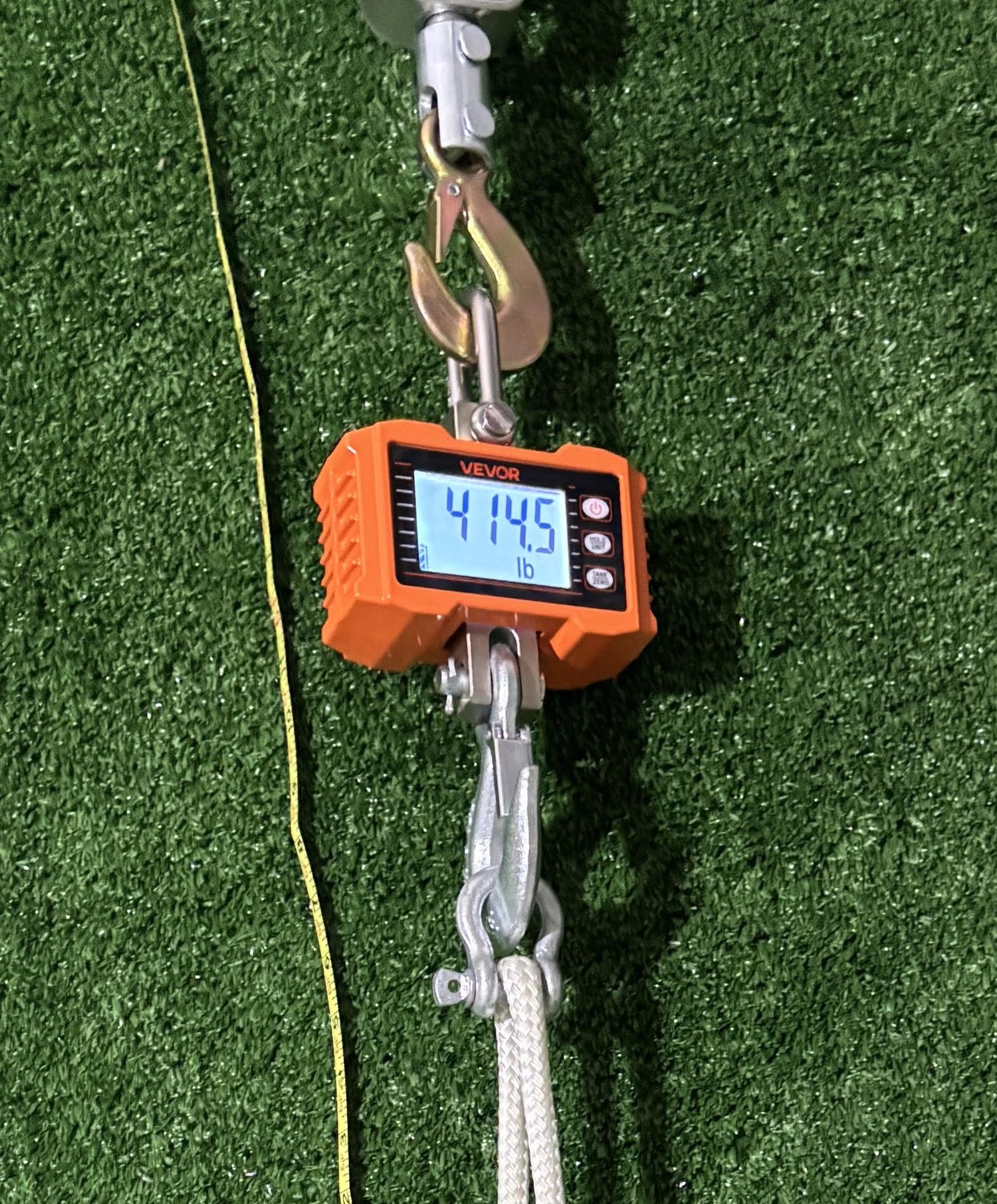
Aircraft tie-down systems are often discussed as if the load is steady and predictable. For example, a pilot might estimate that a parked aircraft wing could experience 500 lb of uplift in a strong wind, then assume the tie-down rope only needs to resist that same 500 lb load.
That is a useful starting point, but it is not the full picture.
A ramp tie-down system may experience both steady loading and dynamic loading. Understanding the difference helps explain why slack, gusts, rope stretch, knots, restraint material, and tie-down geometry all matter.
What Is Steady Loading?
Steady loading is the simpler case. It is the load created when force is applied gradually and held relatively constant.
For example, if wind creates 500 lb of upward demand on one wing and the tie-down rope is already snug, the rope may gradually carry that load as the aircraft tries to lift. This is similar to a static pull test in a lab, where a rope is slowly loaded to a target value and measured.
Static loading is useful because it lets us compare rope stretch, knot tightening, and system movement under controlled conditions.
But wind on the ramp is rarely perfectly steady.
What Is Dynamic Loading?
Dynamic loading occurs when the load changes quickly. A gust, rocking motion, slack event, or sudden rope catch can cause the tie-down system to experience a short-duration load spike higher than the estimated steady load.
This can happen when a wing lifts slightly, the rope stretches, slack is removed, or the aircraft rocks back against the restraint system. The faster the system has to stop movement, the greater the potential peak load.
That is why a tie-down setup that looks adequate under a steady pull may still experience much higher demand during gust-driven motion.
Dynamic Load Factor
A simple way to think about this is with a Dynamic Load Factor, or DLF.
Dynamic Load Formula:
Dynamic Load = Static Load × DLF
The DLF is a multiplier used to estimate how much higher the peak load might be compared with the steady load.
For example, assume a Cessna 172 wing has an estimated steady uplift load of 500 lb during a strong wind event.
500 lb × 1.3 = 650 lb
500 lb × 1.5 = 750 lb
500 lb × 1.8 = 900 lb
The point is not that every tie-down event has a precise DLF. The point is that a 500 lb steady estimate may not remain a 500 lb rope demand under real ramp conditions.
Why Material Stiffness Matters
Different restraint materials can produce different dynamic responses. A material that stretches more can lengthen the stopping distance and may reduce the sharpness of a load spike. A very low-stretch material can stop movement more abruptly, which may increase peak load.
Nylon rope has meaningful stretch compared with many other restraint materials. Polyester generally stretches less than nylon. High-modulus fibers such as Dyneema or Spectra can be much more static, meaning they elongate very little under load. Chain is at the extreme end of the stiffness range because it provides almost no elastic stretch in the tie-down span.
This does not mean one material is always better than another. It means material behavior matters. In a gust-driven event, a stiff system may transmit higher peak loads more abruptly, while a more elastic system may absorb some motion through stretch. The correct comparison is not just breaking strength. It is how the full system behaves under both steady and dynamic loading.
Why Slack Makes It Worse
Slack is one of the biggest reasons dynamic loading matters. If a rope is loose, the aircraft may move before the rope fully engages. When the rope finally catches, the system must stop motion over a short distance.
That can create a sharper load spike than a rope that was already lightly tensioned.
This is why practical preload tensioning matters. The goal is not to crank the aircraft down hard. The goal is to reduce slack so the tie-down system engages earlier and more predictably.
Practical Takeaway
Static load estimates are useful, but gust-driven ramp loading can create short-term peak loads above the steady value. A simple DLF example shows how a 500 lb static wing load might become 650 lb, 750 lb, or 900 lb depending on the dynamic response.
For pilots, the practical lesson is simple: avoid slack, use appropriate rope length, understand tie-down geometry, inspect knots and hardware, and preserve safety margin. Wind loads are not always smooth. Your tie-down system should be prepared for that.
Key Takeaway
Static loading is the steady estimate. Dynamic loading is what can happen when gusts, slack, motion, and material stiffness create short-duration load spikes above that steady value.