A parked aircraft may look still, but its wings do not stop being wings when the engine is off. If wind flows over a parked airplane at the right angle, the wing can still generate lift. That lift becomes an upward force that the aircraft’s tie-down system must resist.
This is one reason tie-downs matter even on a quiet ramp. The aircraft may not be flying, but the wind can still create real aerodynamic loads.
The Basic Uplift Formula
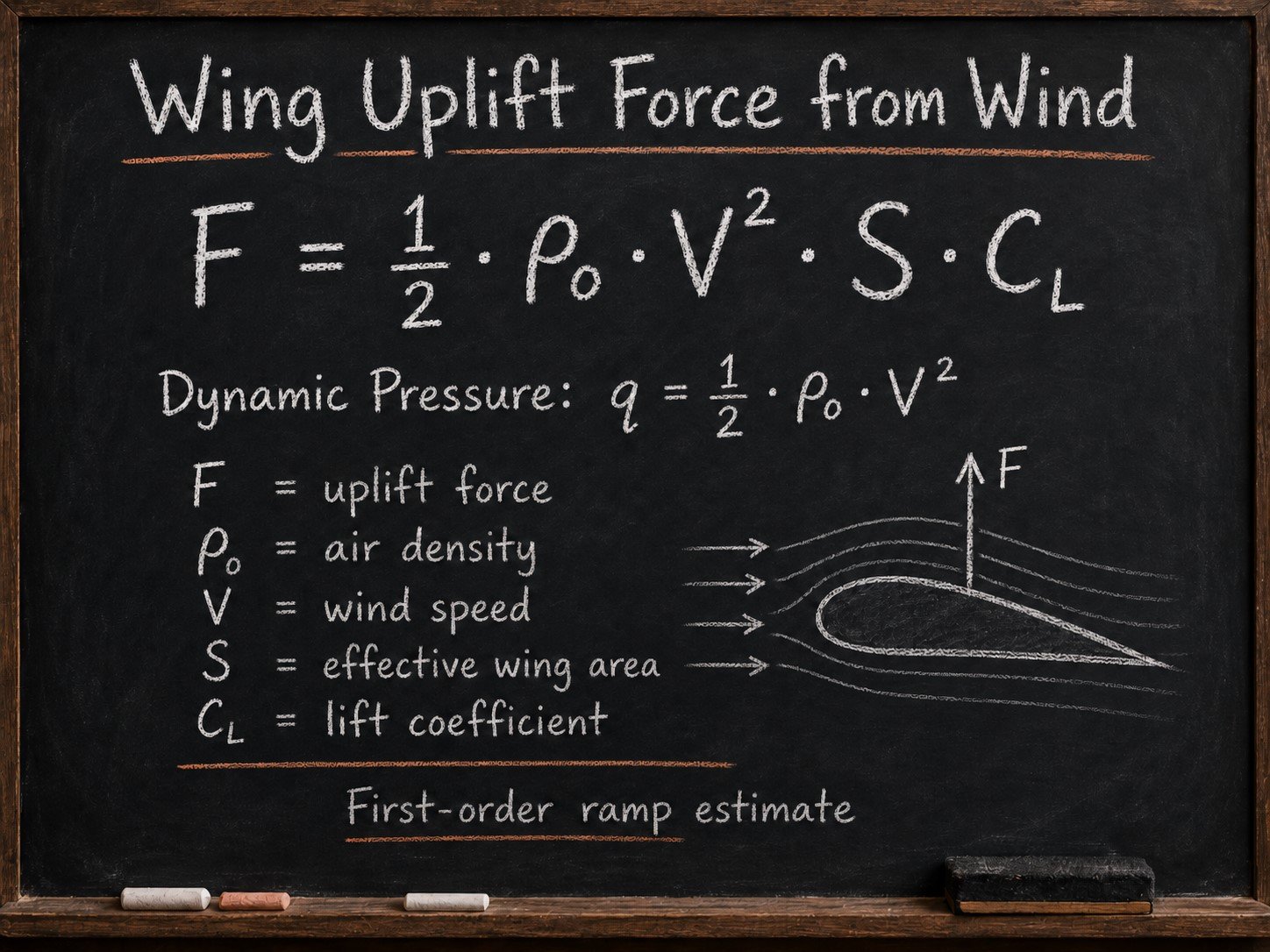
A simple first-order estimate for wind-created uplift is:
F = 1/2 × ρ × V² × S × CL
Where F is uplift force, ρ is air density, V is wind speed, S is effective wing area, and CL is lift coefficient.
The important part for pilots is the V² term. Wind force does not increase in a straight line. It increases with the square of wind speed.
That means a 60-knot wind does not create twice the load of a 30-knot wind. It can create roughly four times the aerodynamic force, assuming the same aircraft, wing area, and lift coefficient.
Cessna 172 Example
For a simplified ramp estimate, assume a Cessna 172-type aircraft with an effective wing area of about 174 square feet and a first-order lift coefficient of 0.50. This is not a certified engineering load case. It is a practical illustration of how quickly wind-created wing loading can grow.
Using sea-level air density assumptions, the approximate total wing uplift can be estimated and then divided by two to show approximate load per wing.
| Wind Speed | Approx. Total Wing Uplift | Approx. Per-Wing Uplift |
|---|---|---|
| 20 kt | 118 lb | 59 lb |
| 30 kt | 265 lb | 133 lb |
| 40 kt | 472 lb | 236 lb |
| 50 kt | 737 lb | 368 lb |
| 60 kt | 1,061 lb | 531 lb |
| 70 kt | 1,445 lb | 722 lb |
The exact numbers will vary with aircraft attitude, gusts, angle of attack, wing contamination, surrounding buildings, wind direction, and how much lift the wing is actually producing. But the trend is the important lesson: wind loading can become meaningful very quickly.
At 60 knots, this simplified example produces roughly 530 lb of uplift per wing. That is no longer a trivial load. It is the kind of force that can pull slack out of ropes, load knots, stretch nylon, and test the entire tie-down system.
Why Tie-Down Geometry Matters
Tie-down rope tension is not always equal to the vertical uplift force. Geometry changes the load in the rope.
If a tie-down rope were perfectly vertical, the rope tension would closely match the vertical uplift demand. But most ramp tie-down ropes are angled outward from the aircraft to the ground anchor. When a rope is angled, only part of the rope tension acts vertically. The rest acts sideways.
That means a lower, shallower rope angle may require more rope tension to resist the same vertical uplift. A strong rope used at poor geometry can be less effective than expected.
Key Takeaway
Wind can create real uplift loads on a parked aircraft. Because aerodynamic force increases with the square of wind speed, the difference between moderate wind and strong gusts can be dramatic. Tie-down strength, rope length, anchor location, and rope angle all matter.