
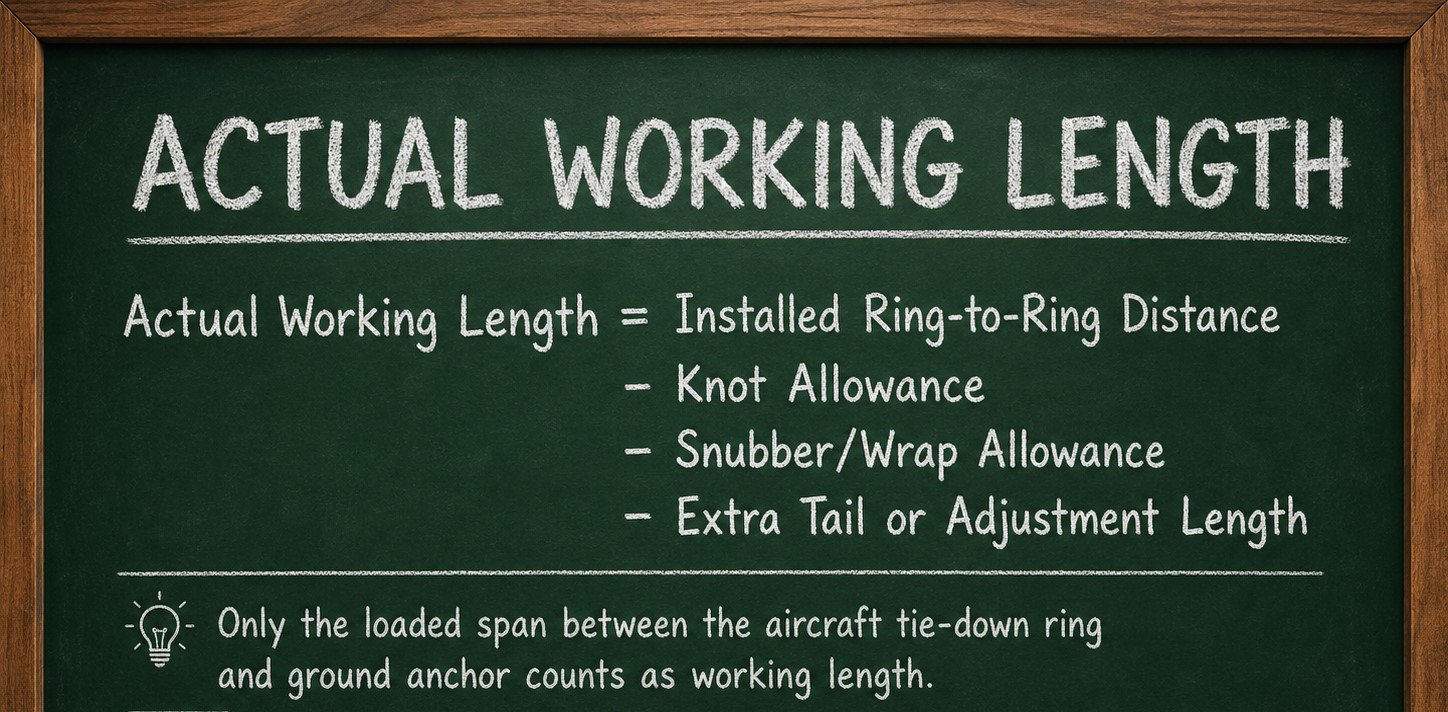
When evaluating an aircraft tie-down rope, one of the most important measurements is not simply the total rope length. It is the actual working length: the portion of the installed rope that is actively carrying load between the aircraft tie-down ring and the ground anchor.
This matters because RampWarden uses a variation of working length as the basis for its tension calculations. A rope that starts as a 15-foot piece may only have 7, 8, or 9 feet of active span once knots, snubbers, wraps, and unused tail length are accounted for. That active span is what determines how the rope behaves when it is pre-tensioned, deflected, stretched, or loaded by wind.
Total Rope Length vs. Actual Working Length
Total rope length is the full physical length of the rope from end to end before it is tied. Actual working length is different. It is the loaded distance between connection points after the rope is installed.
For example, if a rope starts as a 15-foot piece but is tied with a bowline at one end, adjusted with a hitch at the other end, and includes extra tail length for handling, the full 15 feet is not participating in the tie-down span. Only the rope section between the aircraft ring and ground anchor is meaningfully working to restrain the aircraft.
RampWarden principle: The rope you buy is measured end to end. The rope that protects the aircraft is the span that is actually working between the anchors.
Why Working Length Affects Tension
Tie-down rope tension is not only a function of how hard the pilot pulls. It is also affected by span length, rope angle, rope material, rope diameter, knot choice, snubber use, and how much deflection is used to check tension.
A short rope span will feel tighter with less movement. A longer rope span may allow more visible deflection at the same approximate tension. This is why RampWarden’s tension guidance is based on installed geometry rather than a generic “pull it tight” instruction.
Why Knots and Snubbers Must Be Accounted For
Knots consume rope and can shorten the active loaded span. A bowline, midshipman’s hitch, or other securement knot may remove several inches from the usable line depending on how it is tied. Snubbers also change the calculation because the rope is not running in a simple straight line from anchor to aircraft ring.
This does not mean knots and snubbers are bad. They are part of a real-world tie-down system. It simply means they must be accounted for when estimating rope length and tension behavior. When a rubber snubber is used, RampWarden does not treat the entire measured ring-to-ring distance as free rope span. The calculator uses a practical working-length variation that reflects the installed configuration.
Practical Takeaway
Actual working length is the rope length that matters after the tie-down is installed. It is the span that carries load, stretches under force, responds to wind, and determines how the rope behaves during tension checks.
For field use, RampWarden focuses on a practical target: verifying rope tension through a controlled midpoint deflection method. The working length helps define where the midpoint is and how the rope should be evaluated. Without a consistent working-length reference, two pilots could use the same rope and the same force gauge but get different readings simply because their tie-down spans are different.
That is why RampWarden does not rely only on total rope length. Our calculator evaluates the installed geometry and uses a working-length-based approach to provide more useful rope recommendations and field tension guidance.